Guide 6
DermAid Hydrocortisone: 0.5% or 1% - Which One Is Right for You?
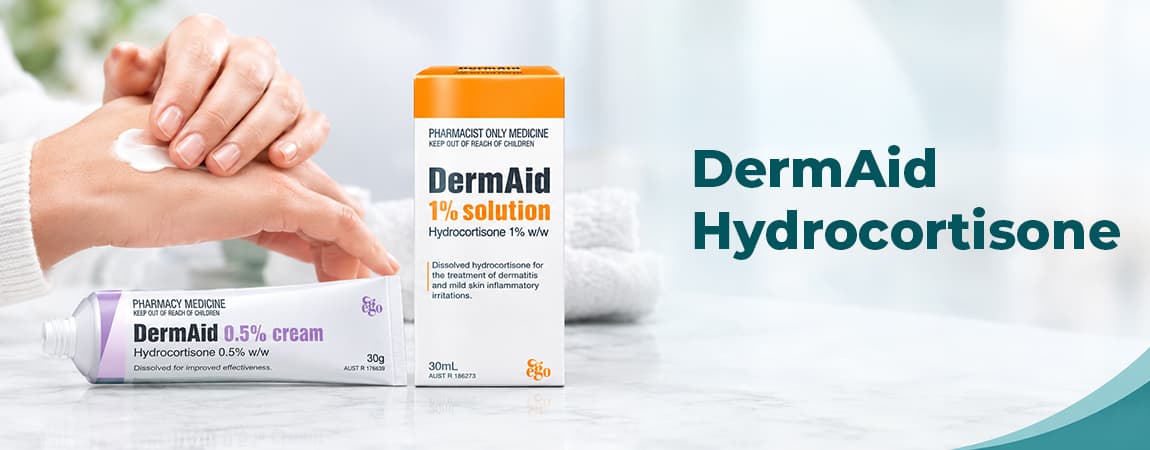
DermAid 0.5% and 1% contain the same active ingredient in different strengths. DermAid 0.5% contains 5 mg of hydrocortisone per gram, while DermAid 1% contains 10 mg per gram. Both are mild, low-potency topical corticosteroids used for the temporary relief of minor inflammatory skin conditions. The appropriate strength depends on the affected area, symptoms, and individual needs.
DermAid 0.5% vs 1% at a Glance
| Feature | DermAid 0.5% | DermAid 1% |
|---|---|---|
| Hydrocortisone per gram | 5 mg | 10 mg |
| Concentration | 0.5% | 1% |
| Topical corticosteroid potency | Mild, low potency | Mild, low potency |
| Common uses | Minor skin irritation, itching and rashes | Minor skin irritation, itching and rashes |
| Suitable for children | Not for children under 2 unless recommended by a doctor | Not for children under 2 unless recommended by a doctor |
| Available formats | Cream | Cream, solution and spray |
| How supplied | Check the label and pharmacist advice* | Ask your pharmacist* |
*Supply requirements depend on the strength, formulation and pack size. Ask your pharmacist about DermAid 1% and check the label for the product you are buying.
The strength is only one part of the decision. Where the product is applied, how much is used, and how long it is used also matter. Always follow the directions on the pack or advice from your pharmacist or doctor.
DermAid 0.5% and 1%: What Is the Difference?
The main difference is the amount of hydrocortisone in each product. DermAid 0.5% contains 5 mg of hydrocortisone per gram, while DermAid 1% contains 10 mg per gram.
Both are mild, low-potency topical corticosteroids. DermAid 0.5% is the lower-strength option, while DermAid 1% contains twice the concentration of hydrocortisone.
That does not mean the 1% cream is automatically the better choice. The right product depends on the condition being treated, the location of the affected skin, and the directions provided with the medicine.
Which DermAid Strength Should You Use?
There is no single strength that is right for everyone.
DermAid 0.5% and DermAid 1% are both intended for the temporary relief of minor inflammatory skin conditions. If you are unsure which strength to use, speak with your pharmacist, particularly if the affected area is on the face, around the eyes, in a skin fold, or on a child. Ego Pharmaceuticals specifically advises discussing the most suitable strength with a pharmacist.
Avoid choosing the stronger product simply because the symptoms seem troublesome. Using more hydrocortisone than recommended does not necessarily clear the condition faster and may increase the risk of unwanted effects.
What Does Hydrocortisone Cream Treat?
Hydrocortisone is a corticosteroid that reduces inflammation in the skin. DermAid products are used for temporary relief of symptoms associated with corticosteroid-responsive conditions.
Depending on the formulation, these include minor skin irritation, itching, and rashes associated with conditions such as:
- Eczema
- Dermatitis
- Contact dermatitis, including reactions to cosmetics or jewellery
- Psoriasis
- Insect bites
- Sunburn
- Other corticosteroid-responsive skin conditions
DermAid is not an antifungal or antibacterial treatment. If a rash may be caused by an infection, it is important to seek appropriate medical advice rather than relying on hydrocortisone alone.
Where Should You Not Use DermAid?
Always read the label and follow the directions for use.
DermAid is for external use only. Do not use it in the eyes or for acne. Do not use it on children under 2 years of age, under waterproof bandages, or for more than 7 days unless recommended by a doctor. If irritation occurs, discontinue use.
If symptoms persist, worsen, or you are unsure whether hydrocortisone is suitable, speak with your doctor or pharmacist. Seek medical advice if the skin appears infected, is extensively damaged, or the condition is not improving.
How Long Can You Use DermAid For?
DermAid is intended for short-term use. Current Australian product information for DermAid 0.5% and 1% advises not using the cream for more than 7 days unless recommended by a doctor.
Using a topical corticosteroid for longer than recommended can increase the risk of skin-related side effects. If the symptoms continue after the recommended period, or return repeatedly, speak with a healthcare professional rather than continuing treatment on your own.
What Is the Difference Between DermAid and DermAid Soft?
Both DermAid and DermAid Soft contain hydrocortisone, but they are different formulations.
DermAid Soft is available in 0.5% and 1% strengths. Ego describes DermAid Soft 0.5% as suitable for sensitive areas. Both the standard DermAid creams and DermAid Soft creams contain added emollients; this feature is not exclusive to the Soft range.
The wider DermAid range also includes a 1% solution, designed for areas such as the scalp, and a 1% spray, which can be useful for hairy or difficult-to-reach areas.
The best format depends on where the product needs to be applied and the advice provided with the product.
Should You Moisturise as Well?
Moisturising can be an important part of managing dry or irritated skin.
Hydrocortisone helps reduce inflammation, while an emollient can help moisturise and support the skin barrier.
They therefore serve different purposes and may be used as part of the same skincare routine.
For specific advice about combining DermAid with an emollient, ask your pharmacist or doctor and follow the directions provided with both products. The Australian Consumer Medicine Information for DermAid 1% also notes that an emollient such as QV Cream may provide additional relief for dry skin between applications.
Where to Buy DermAid in Australia
Joya Medical Supplies provides access to a range of healthcare and skincare products, including DermAid products where available.
The DermAid range includes 0.5% and 1% creams, along with other formulations such as DermAid Soft, solution and spray.
Product availability and supply conditions can vary, so check the individual product page for current information.
Joya Medical Supplies makes it easy to browse healthcare products online and order from anywhere in Australia.
When to Speak to a Healthcare Professional
Consider speaking with a doctor or pharmacist before using DermAid if:
1. The skin is broken or weeping
Open or damaged skin may require a different approach and should be assessed appropriately.
2. You think the skin may be infected
Increasing redness, warmth, swelling, pus, or crusting can indicate infection and needs appropriate assessment.
3. The affected area is near the eyes
The skin around the eyes is delicate. Do not use DermAid in the eyes and seek professional advice about treatment near this area.
4. Symptoms do not improve
If symptoms persist beyond the recommended treatment period or keep returning, seek medical advice rather than repeatedly using the cream.
Shop DermAid at Joya Medical Supplies
DermAid 0.5% and 1% provide different concentrations of the same active ingredient, hydrocortisone. Choosing between them is not simply about selecting the stronger cream. The affected area, symptoms, age, and product directions all need to be considered.
Explore the DermAid range at Joya Medical Supplies and check the individual product information before purchasing:
- DermAid 0.5% Cream 30g
- DermAid 1% Cream 30g
- DermAid Soft 0.5% Cream 30g
- DermAid Soft 1% Cream 30g
- DermAid 1% Solution 30ml
- DermAid 1% Spray 30ml
If you are unsure which product or strength is appropriate, speak with your pharmacist or doctor.
FAQ
- What is the difference between DermAid 0.5% and 1%?
- They contain the same active ingredient, hydrocortisone, at different concentrations. DermAid 0.5% contains 5 mg per gram, while DermAid 1% contains 10 mg per gram. Both are mild, low-potency topical corticosteroids used for temporary relief of minor inflammatory skin conditions.
- Can you use DermAid on your face?
- DermAid should not be used in the eyes. Facial skin is delicate, so speak with a pharmacist or doctor before using a topical corticosteroid on the face. Ego specifically identifies DermAid Soft 0.5% as suitable for sensitive areas such as facial skin, with appropriate caution.
- Is hydrocortisone a strong steroid?
- Hydrocortisone is considered a mild, low-potency topical corticosteroid. Ego describes the DermAid range as providing temporary relief of minor skin irritation, itching, and rashes.
- How long can you use DermAid cream?
- DermAid 0.5% and 1% cream should not be used for more than 7 days unless recommended by a doctor. If symptoms persist, worsen, or return, speak with your doctor or pharmacist.
- What is the difference between DermAid and DermAid Soft?
- Both ranges contain hydrocortisone and added emollients, but their cream formulations differ. DermAid Soft is available in 0.5% and 1% strengths. Ask your pharmacist which formulation is suitable for your skin.