Guide 8
Foam Dressings Compared: Mepilex vs Allevyn and When You Need a Border
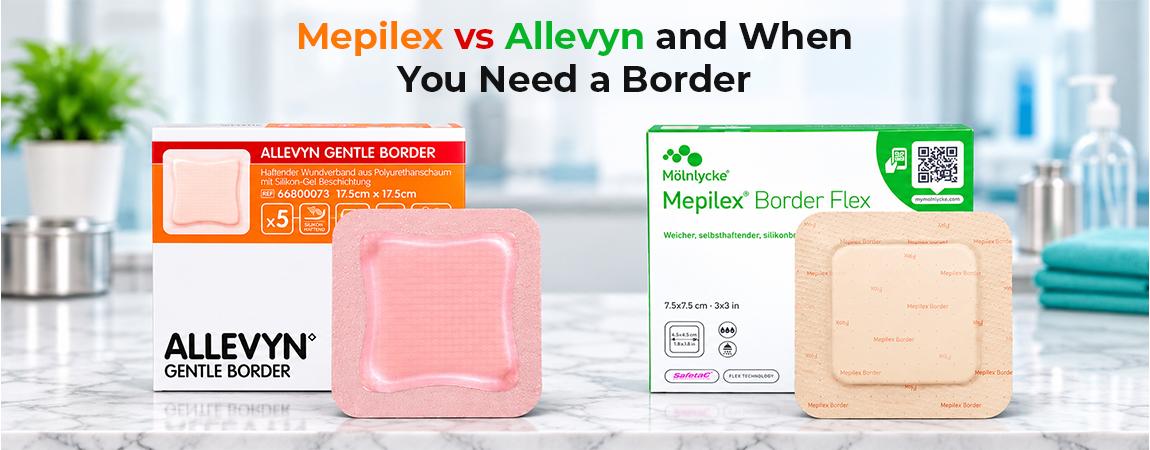
Mepilex and Allevyn are foam dressing ranges used to manage wound fluid. Mepilex dressings use a soft silicone contact layer; Allevyn includes silicone and non-silicone options. The right choice depends on the wound, fluid level, surrounding skin, and fixation needs. Bordered dressings have an adhesive edge, while non-bordered dressings generally need separate fixation.
Mepilex and Allevyn at a Glance
| Dressing | Border | Absorbency | Product check | May be suitable when |
|---|---|---|---|---|
| Mepilex (plain pad) | No | Low to moderate exudate | Check exact product instructions | You are securing it with tape, a bandage, or a compression system |
| Mepilex Border | Yes | Moderate to high | Check exact product instructions | You want an all-in-one dressing that stays in place on its own and can be used when showering |
| Mepilex Border Flex | Yes | Moderate to high | Check exact product instructions | You need a conformable dressing for an area that moves; check the appropriate shape |
| Mepilex Lite | No | No to low exudate | Check exact product instructions | A clinician recommends a thin foam for a non- or lightly exuding wound |
| Mepilex Ag / Border Ag | Both exist | Varies: plain Mepilex Ag is for low to moderate exudate; check bordered product instructions | Check exact product instructions | A clinician identifies a need for an antimicrobial dressing |
| Allevyn Gentle Border | Yes | Moderate to high | Check exact product instructions | You want a bordered foam dressing similar to Mepilex Border |
| Allevyn Life | Yes | Exudate management with a change indicator | Check exact product instructions | The fluid-management features and change indicator suit the wound care plan |
| Allevyn Non-Adhesive | No | Moderate to high | Check exact product instructions | You need a non-adhesive option under compression or for fragile skin |
Fluid-management descriptions are product-specific and are not a direct ranking of absorbency between brands. Check the exact product instructions and wound care plan.
Choose a foam dressing by the wound's needs and the specific product instructions, including fluid management, skin sensitivity, fixation, and whether an antimicrobial dressing is indicated. For how foam fits among other dressing types, see the Wound Dressing Selection Guide.
What Does a Foam Dressing Actually Do?
A foam dressing has a few important jobs. It absorbs the fluid a healing wound gives off, helping keep the surrounding skin from becoming too wet and breaking down. It also cushions the wound, which can be particularly useful over areas such as the heel or a bony hip.
Some foam dressings have a soft silicone wound-contact layer designed to reduce pain and trauma during removal. Others use different contact layers, so check the specific product rather than assuming all foam dressings contain silicone.
Mepilex vs Allevyn: Which One Should You Choose?
There is no single winner between Mepilex and Allevyn. For many wounds, either range may be suitable. The right option depends on the wound, the amount of fluid, where the dressing needs to sit, and how it will be secured.
If a nurse or other healthcare professional has recommended a particular dressing, it is usually best to continue with that product unless they advise otherwise.
Mepilex may be suitable when
- A particular shape or size in the range fits the wound and surrounding area.
- You are reordering a product already recommended in the wound care plan.
- A healthcare professional recommends Mepilex Lite for a wound with no or low levels of exudate.
- You need a conformable bordered dressing, such as Mepilex Border Flex, for an area that moves.
Allevyn may be suitable when
- A healthcare professional recommends Allevyn Life for its fluid-management features.
- The Allevyn Life change indicator would help guide dressing changes alongside the wound care plan.
- Your facility uses Smith+Nephew products, and the selected dressing meets the wound's needs.
- A non-adhesive foam is recommended under a prescribed compression system.
What should not decide it: price alone. A dressing that costs less but needs to be changed more often may not be the most cost-effective option overall.
Do You Need a Bordered Foam Dressing?
A border is a thin adhesive frame around the foam pad, so the dressing sticks to the skin on its own. A simple way to decide is to consider what will hold the dressing in place.
- Nothing else is holding it. A bordered dressing may be the more practical option. Mepilex Border or Allevyn Gentle Border have an adhesive border to help keep the dressing in place.
- A bandage or compression system is going over the top. A non-bordered pad may be suitable, but bordered dressings can also be used under compression when appropriate. Follow the prescribed wound care plan rather than ruling out an adhesive border.
- The skin around the wound is very fragile. Ask your healthcare professional which contact layer and fixation method will minimise skin trauma. A silicone-bordered or non-bordered dressing may be suitable depending on the wound and skin condition.
- It is on a heel, elbow, or shoulder. A shaped or flexible dressing can help it sit more securely on areas that move or have a curved surface.
When Is a Silver Foam Dressing Appropriate?
Silver foam dressings, such as Mepilex Ag, may be selected when a healthcare professional identifies a need for an antimicrobial dressing, including signs of local infection or a significant risk of infection.
Silver is not needed for every wound. Its use should have a clear clinical purpose and a planned review. Speak with your healthcare professional before choosing a silver dressing.
The treating healthcare professional should set the review date and duration of antimicrobial dressing use; do not apply a single course length to all wounds.
Seek prompt clinical assessment for increasing wound pain, spreading redness, swelling, pus, an unusual smell, or deterioration. Seek urgent care if you also have fever or feel unwell. A dressing alone may not be sufficient to treat an infection.
How Often Should a Foam Dressing Be Changed?
Some foam dressings can remain in place for several days. Change them according to the product instructions and wound care plan, and sooner if they leak, become loose or soiled, or reach the product's change threshold. Do not exceed the maximum wear time for the specific dressing.
If you are caring for a wound at home, follow the dressing schedule provided by your healthcare professional rather than relying on a set number of days.
What Size Dressing Do You Need?
Choose a dressing with an absorbent pad that covers the wound and extends onto surrounding intact skin by the margin specified in the product instructions. The total dressing dimensions include any adhesive border and are not the same as the pad dimensions. Ask your healthcare professional if you are unsure which size to use.
Choosing the right size can help you avoid unnecessary changes and make sure you have enough dressing coverage.
Where to Buy Mepilex and Allevyn in Australia
Browse Mepilex and Allevyn products at Joya Medical Supplies, including foam dressings. Check each listing for the dressing format, pack quantity, current availability, and delivery information. Contact Joya to confirm account eligibility and ordering arrangements.
Not sure which dressing or size you need? If you already have the product at home, send us a photo of the packaging and our team can help identify the product code.
Check the exact product code and pack quantity when reordering to ensure you receive the dressing specified in your wound care plan.
FAQ
- What is the difference between Mepilex and Mepilex Border?
- Standard Mepilex is a non-bordered foam dressing that generally needs separate fixation. Mepilex Border has an adhesive border. Showering suitability depends on the exact product and whether it is applied and sealed correctly; follow its instructions.
- Is Allevyn the same as Mepilex?
- They are different foam dressing ranges. Mepilex is made by Mölnlycke and uses a soft silicone contact layer. Allevyn is made by Smith+Nephew and includes silicone and non-silicone products. Compare the specific products rather than treating the ranges as interchangeable.
- How long can you leave a Mepilex dressing on?
- Wear time depends on the exact Mepilex product, wound condition, and wound care plan. Follow the product's maximum wear time and change it sooner if it leaks, loosens, becomes soiled, or reaches its specified change threshold.
- Can you shower with a Mepilex Border on?
- Some Mepilex Border products are showerproof when correctly applied with an intact seal. Check the instructions for your exact dressing. After showering, gently dry it and check the edges; replace it as directed if water has entered or the seal has loosened.
- Do I need a silver dressing like Mepilex Ag?
- Silver dressings are intended for wounds where there is a clinical reason to use an antimicrobial dressing, such as infection or a significant risk of infection. They are usually used for a set period rather than ongoing. If you have not been advised to use a silver dressing, speak with your healthcare professional before choosing one.